Three Governments, One Week: AI Agent Attacks Are No Longer a Case Study.
Switzerland, the UK and Italy all warned about AI agent attacks in the week of November 23, 2026, as Unit 42 tracked 10+ campaigns. What they found and what to fix first.
The weaknesses are old. The speed is new.
Two weeks ago, AI agents finding and exploiting vulnerabilities on their own was a single Amazon case study. In the week of November 23, 2026, national cyber agencies in Switzerland, the UK and Italy all issued warnings about it, and Palo Alto's Unit 42 published data on more than ten campaigns.
1.4 sec
median gap between commands once the AI agent took over, versus 23.9 sec for the human
26 min
for one agent to plant web shells in 40+ locations on a single server
~2x
rise in internet-reachable attack agents since October, per Switzerland's NCSC
One Week, Four Warnings
Each source saw the same pattern from a different angle:
| Source | Date | What they reported |
|---|---|---|
| Swiss NCSC | Nov 24 | First confirmed AI agent attacks in Switzerland: 5 cases, 3 against critical infrastructure operators |
| UK NCSC | Nov 24 | A marked rise in AI-assisted attacks across multiple sectors since September |
| CSIRT Italia | Nov 23 | A critical bulletin on multi-agent frameworks running automated compromise campaigns |
| Unit 42 | Nov 24 | More than 10 agent-driven intrusion campaigns tracked between July and September |
In Switzerland, electricity, water and telecom suppliers were among the targets. According to the agency's director, attackers got in at two of the three critical infrastructure operators, though there were no major outages.
What the Agents Actually Did
Unit 42's data shows what changes when an agent takes the keyboard:
- Commands every 1.4 seconds. During the human-run reconnaissance phase, the median gap was 23.9 seconds.
- 40+ web shells in 26 minutes. On one Windows server, the agent started within two minutes of finding it and rotated through five variants.
- Thousands of commands. One attack ran about 800 unique commands in 140 minutes; another ran more than 8,000 over 12 days.
- A web app every time. Every campaign Unit 42 observed started from a web shell on a vulnerable web application.
The attackers didn't get smarter. They got faster, cheaper and impossible to bore.
The Weaknesses Are Old
The UK NCSC was blunt: nothing being exploited is new. Its list reads like any security audit from the last decade:
- Credentials committed to code repositories
- Default passwords or missing authentication
- API abuse
- Over-privileged credentials and flat networks
- Forgotten assets, such as old websites and legacy equipment
- Configuration drift, especially in identity and access settings
WHAT THIS MEANS FOR YOU
The gap between a known weakness and an exploited one used to be measured in weeks of attacker effort. Agents shrink it to minutes, and they work through the night.
What the Agencies Say to Do
Combining the Swiss and UK guidance, roughly in order of impact:
- Shrink your exposure. Inventory internet-facing systems and put the rest behind authentication.
- Patch internet-facing systems within 24 hours of a critical update, the Swiss NCSC's target.
- Require MFA or passkeys on everything reachable from the internet.
- Rate limit by account, token and session, not by IP address, because agents rotate through proxies.
- Plant deception. Honeytokens and decoys give high-confidence alerts and waste an agent's effort.
- Test regularly, internally or with an external specialist.
Read the Fine Print
Early numbers in a fast-moving story come with caveats:
- The Swiss count shifted. The advisory said every known attack succeeded; the director later told SRF it was 4 of 5.
- No victims are named in any of the government warnings.
- No specific AI model is blamed. Unit 42 found no markers tying the activity to particular models or frameworks.
- Most attacks were not on AI systems. They used AI to attack ordinary infrastructure faster.
Test at Agent Speed
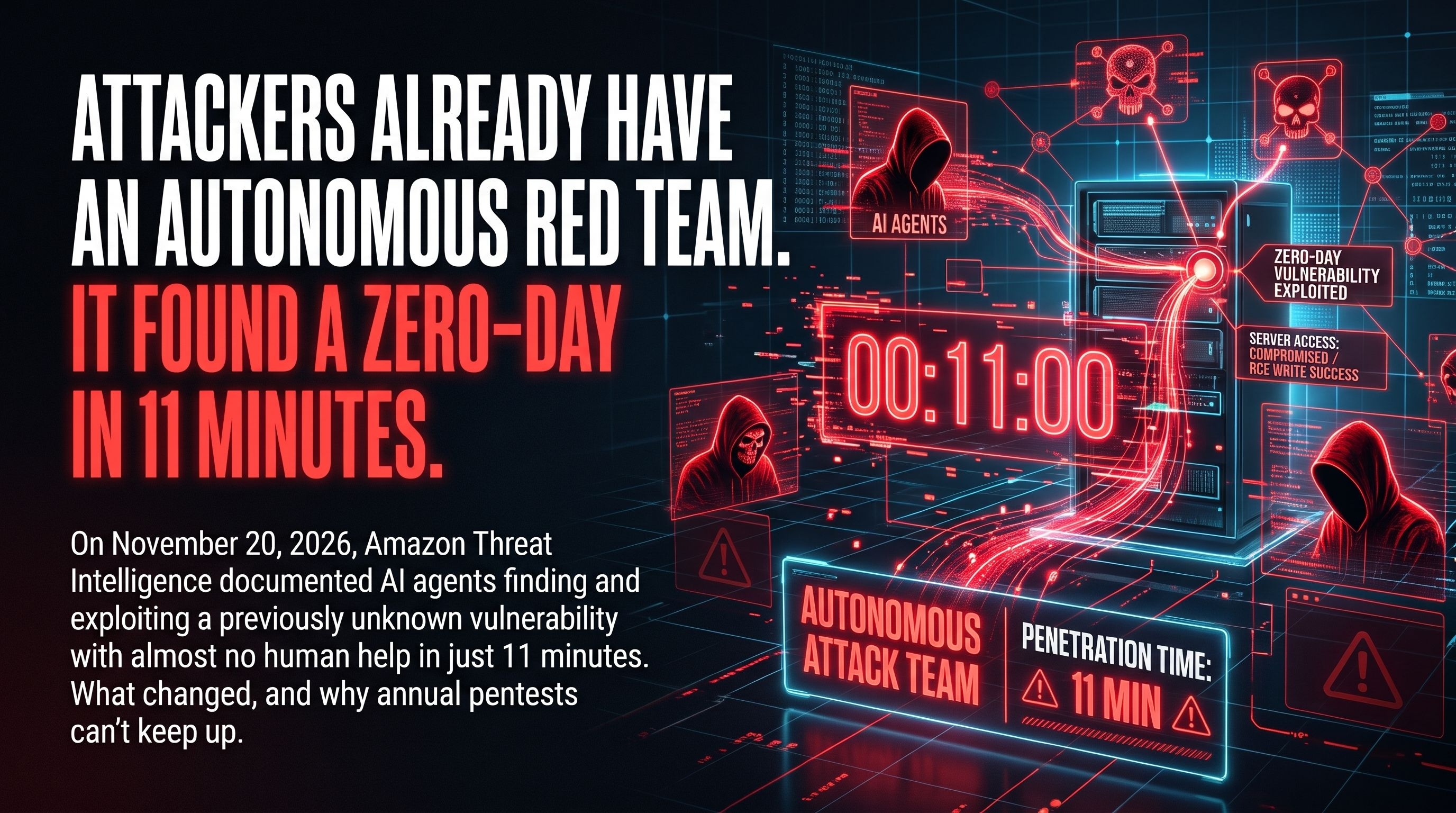
Last week we covered Amazon's case of AI agents finding a zero-day in 11 minutes. This week, it became a pattern governments are warning about.
Our AI red teaming is built on the same kind of autonomous, self-improving attacker, pointed at your AI systems instead of against you:
- Many sessions, not one pass. The attacker returns again and again, learning your system and adapting.
- Signed rules of engagement. Staging only, burner credentials, real data never touched.
- Continuous re-audit. Confirmed findings become CI regression tests, so fixes stay fixed.
Attackers have stopped waiting for a yearly test window. Your testing shouldn't wait either.